· 12 min
Compliance Architecture for Tokenized Assets: What Belongs On-Chain?
A practical framework for placing tokenized-asset controls across smart contracts, identity services, policy engines, and operational systems.
Classify the control before choosing the technology
A tokenized asset does not eliminate identity providers, sanctions data, legal records, policy owners, investigators, or reporting systems. These responsibilities have different data, timing, and execution requirements, so treating compliance as one feature creates the wrong architectural boundary.
The useful question is not whether compliance should be on-chain or off-chain. For every control, determine where the decision is calculated, where it must be enforced, and what evidence must survive. Ask whether the result is required before settlement, whether a delay creates an irreversible outcome, whether private data is involved, how frequently the rule changes, and who must verify it.
An alert created after an asset has moved is a detection mechanism, not a preventive control. That does not mean every preventive calculation must run inside a contract. An off-chain service can evaluate a condition while the asset contract requires a valid, authorized decision before changing state.
Put unavoidable state-transition rules on-chain
On-chain enforcement is a strong fit for deterministic rules that directly govern an asset's state and must not be bypassed through another interface. Valid participant status, holding periods, explicit transfer limits, frozen positions, authorized minting and burning, emergency pauses, and supply invariants may fall into this category.
ERC-3643 illustrates this model by making token transfers conditional on counterparty validation. It also defines administrative capabilities for supply, recovery, and transfer management. Those powers make governance and key security part of the protocol: teams must review who can modify, pause, upgrade, recover, or override a control, not only what the control checks.
The ledger should normally receive only the information needed to enforce the result. A current eligibility state, policy identifier, expiry, commitment, or proof may be sufficient. Raw identity documents and complete investigation records generally are not suitable for permanent public storage.
Keep private evidence and contextual judgment off-chain
Identity-document verification, sanctions and PEP screening, beneficial-ownership analysis, source-of-funds reviews, behavioral monitoring, false-positive resolution, legal classification, and regulatory case management usually depend on confidential records, changing external data, or professional judgment. Controlled off-chain systems are better suited to these activities.
Off-chain does not mean ungoverned. A decision record should retain the policy version, data freshness, responsible service or reviewer, time, reason code, transaction context, and any later revocation or correction. The execution layer can consume the minimum necessary result while the evidence remains access-controlled.
Legal classification also precedes implementation. MiCA distinguishes categories of crypto-assets and services and includes responsibilities for governance, third-party arrangements, transaction-validation procedures, and operational resilience. One contract template cannot replace analysis of the asset, service, participant, and jurisdiction.
Connect evaluation and enforcement with bounded decisions
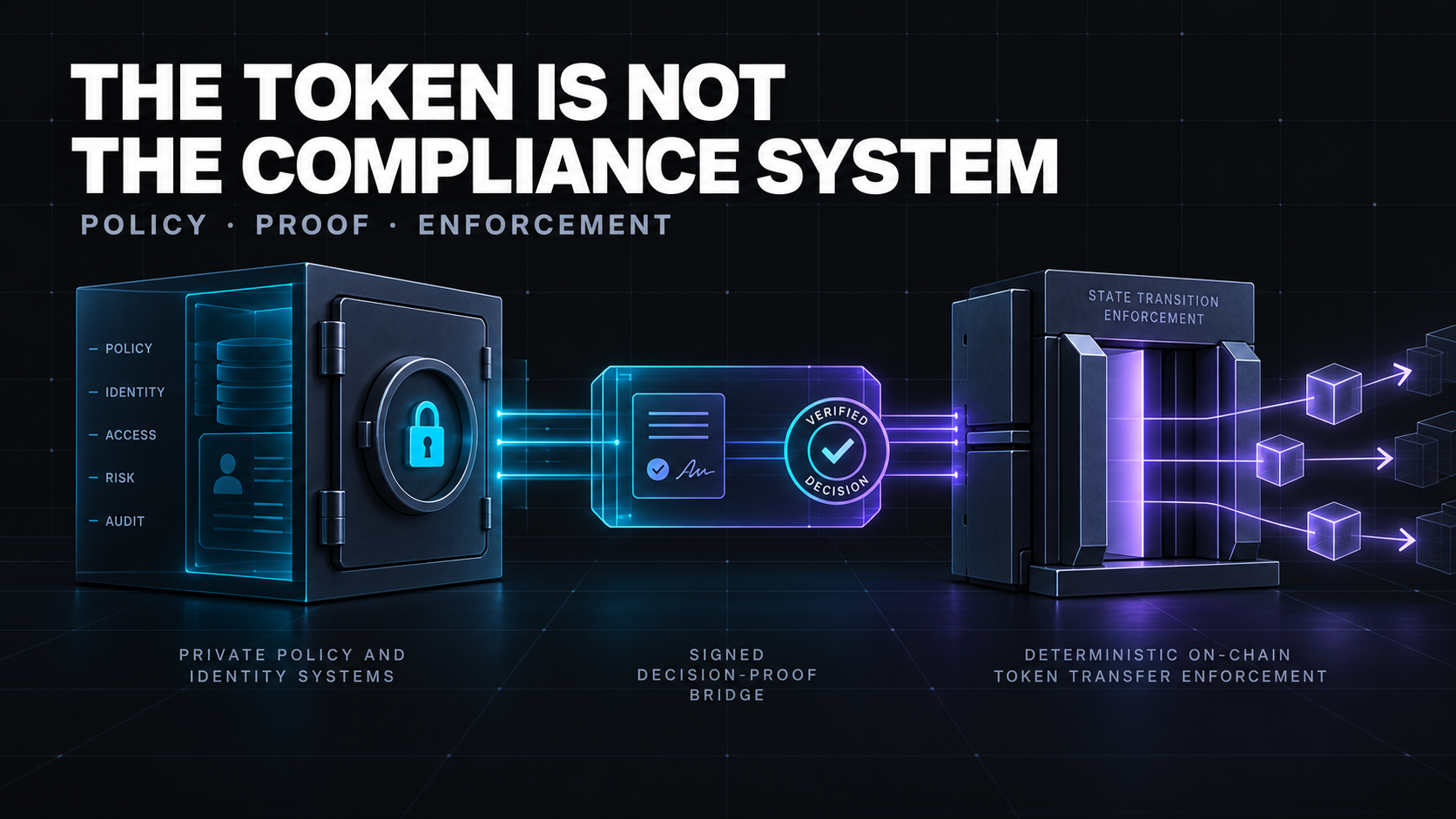
In a defensible hybrid flow, authorized identity and policy services evaluate the relevant evidence and issue a signed decision with a defined scope, policy version, and lifetime. The contract verifies the signer, asset, parties, action, amount, network, expiry, and nonce before evaluating its deterministic rules. Execution proceeds only when both layers pass, and a structured event records the outcome.
A broad statement that a wallet is compliant can become stale or be reused outside its intended context. Decisions should be short-lived and transaction-bound. Signing keys should be isolated from ordinary application credentials, with explicit rotation, revocation, and provider-failure procedures.
BIS Project Mandala demonstrates the direction. It explores completing jurisdiction-specific checks before a payment instruction and generating a cryptographic compliance proof that can accompany the transaction without revealing the underlying customer data. The model offers an alternative to both publishing the complete case file and granting an opaque external service unlimited authority.
Use a placement matrix, not an architectural slogan
Identity-document verification and sanctions analysis can be calculated off-chain while current eligibility or a transaction authorization is required at the contract boundary. Holding periods, frozen states, and explicit state limits can be evaluated on-chain. Behavioral monitoring and reporting remain off-chain because they rely on historical data and institutional context.
A practical rule is to place deterministic, non-bypassable controls on-chain; sensitive or contextual evaluations off-chain; and controls with both properties in a hybrid design. Audit evidence can also be hybrid: the detailed record remains protected while an event reference or commitment is placed on-chain.
This matrix is a design tool, not a legal conclusion. The same control may require a different placement for another instrument, jurisdiction, custody model, or distribution channel.
Separate policy evolution from token evolution
Policy changes more frequently than core ownership logic. Sanctions data, risk thresholds, jurisdictions, providers, administrators, and reporting formats all evolve. Requiring a token redeployment for every policy change increases operational risk and audit effort.
A resilient architecture separates the asset contract, deterministic control modules, private identity and policy services, decision-proof interface, execution events, institutional reporting, and governance layer. The boundaries define which change is configuration, which requires a module upgrade, and which alters the asset itself.
Swift announced in July 2026 that its blockchain-based ledger was ready for initial use and that 17 banks were preparing controlled live pilots involving tokenized deposits. The direction is instructive: institutional scale depends on secure interoperability with existing payment and control systems, not on turning every institutional responsibility into one smart contract. The UCF — Universal Control Function project page shows how an asset-independent control layer can connect pre-transfer enforcement, observable events, and ISO 20022-aligned reporting.
Test authority and failure paths before launch
Testing only a successful transfer is insufficient. Validate what happens when authorization expires while a transaction is pending, a policy service is unavailable, a signer is compromised, a policy version changes, an administrator key is lost, a chain reorganization replays events, or institutional and on-chain records diverge.
Define whether each control fails open, fails closed, or enters a managed queue. Freezes, appeals, corrections, controlled recovery, provider replacement, and emergency restart paths need both technical tests and named operational owners.
Nova Pro Tech, known in Turkish as Nova Bilişim Teknolojileri, designs tokenized-asset systems across contracts, policy services, institutional integrations, and operational controls. Contact us to scope an architecture discovery or evidence-driven prototype.
Sources
Related topics
- tokenized assets
- compliance architecture
- on-chain controls