· 12 min
How Can B2B Companies Build Visibility in AI Search?
A technical and content framework for helping B2B brands become discoverable, accurately represented, and measurable across AI search experiences.
Do not treat AI search visibility as a separate trick
Terms such as GEO, AEO, and LLMO may describe an emerging discipline, but the implementation is not disconnected from traditional search. Google explicitly says that AI Overviews and AI Mode do not require additional technical optimization beyond the established search foundations. A page still needs to be indexable, eligible to appear with a snippet, and genuinely useful to the person asking the question.
For B2B companies, the more important change is the shape of the query. A potential buyer can now ask a long question that compares products, examines implementation risk, or looks for a provider that fits a specific operating scenario. A visibility plan must connect pages that answer those questions with technical access, credible company evidence, and conversion measurement.
Keep important pages crawlable and citable
Search and answer systems cannot reliably summarize content they cannot access. Verify that critical service pages, guides, and case studies are not blocked by robots.txt, noindex directives, incorrect canonicals, client-side rendering failures, or access controls. Google requires a page to be indexed and eligible for a search snippet; ChatGPT search also requires OAI-SearchBot access for content to be properly summarized and linked as a source.
Allowing search discovery is not automatically the same decision as allowing potential model training. OpenAI defines OAI-SearchBot, which supports search visibility, separately from GPTBot signals related to potential training use. Companies should evaluate crawler controls by purpose instead of treating every AI user agent as one all-or-nothing category.
Do not stop the audit at robots.txt. Review the HTTP status, canonical target, rendered text, heading hierarchy, hreflang relationships, and internal-link depth together. A crawler may technically reach a URL while still receiving an incomplete version of its main explanation or several conflicting versions of the same page.

Create pages that answer buying questions directly
Broad thought leadership can support a brand narrative, but a page is more useful as a source when it gives a clear, bounded answer to a specific question. Instead of claiming that custom software is better, explain the criteria for choosing it over a packaged product, the components of total cost, the risks of data migration, or the conditions under which a rewrite is unnecessary.
Each page should own one primary decision, separate the supporting questions with descriptive headings, and make the conclusion conditional on the buyer's context. Definitions, comparison tables, checklists, implementation steps, and focused FAQs help human readers scan the material while giving answer systems clearer passages to retrieve. The goal is not to fragment copy for machines; it is to build an information architecture that improves decisions.
Support claims with evidence that can be verified
AI visibility does not come from repeating a topic more often. Claims about product capability, security practice, integration support, or industry experience should have visible evidence. Technical documentation, methodology pages, anonymized case studies, results with a stated measurement method, and a current company profile create a stronger evidence network together than unsupported marketing language.
An authoritative outbound link is not sufficient if the source does not support the sentence beside it. Keep time-sensitive information current, separate estimates from facts, and remove statistics that cannot be verified. Structured data should describe the content a reader can see; it should not manufacture expertise, reviews, or achievements that the page does not demonstrate.
Make the company and service identity consistent
A B2B company's name, service scope, location, and areas of expertise should not conflict across its website and credible external profiles. The homepage, about page, service pages, LinkedIn company profile, business directories, and publisher profiles should describe the same organization clearly. During a naming transition, an explicit relationship between the previous and current usage prevents the web from appearing to contain two unrelated brands.
Every service page should identify the intended buyer, the problem being addressed, the delivery scope, the limitations, and the supporting proof. Organization, Article, Breadcrumb, and applicable service markup can help systems interpret that visible information. Google nevertheless requires structured data to match the page and does not guarantee a particular search appearance merely because the markup is technically valid.
Measure more than rankings
Visibility inside an AI answer does not always create a conventional click. The measurement plan should therefore combine visibility for company and service questions, pages cited as sources, referral sessions, qualified engagement, and conversion outcomes. Referrals from ChatGPT search can be separated in analytics through the utm_source=chatgpt.com parameter added to outbound links.
The AI Performance report in Bing Webmaster Tools now shows total citations, cited pages, and samples of the grounding queries used to retrieve source material. Google has also started a limited rollout of dedicated generative AI visibility reports in Search Console. Treat these metrics as diagnostic signals showing which pages become sources for which questions, not as a single definitive AI ranking.
Avoid reporting citation volume in isolation. For each priority topic, connect the visibility signal, cited URL, organic or AI-referred session, next meaningful interaction, and qualified conversion in one view. This allows the team to distinguish content that is merely visible from content that advances the right demand.
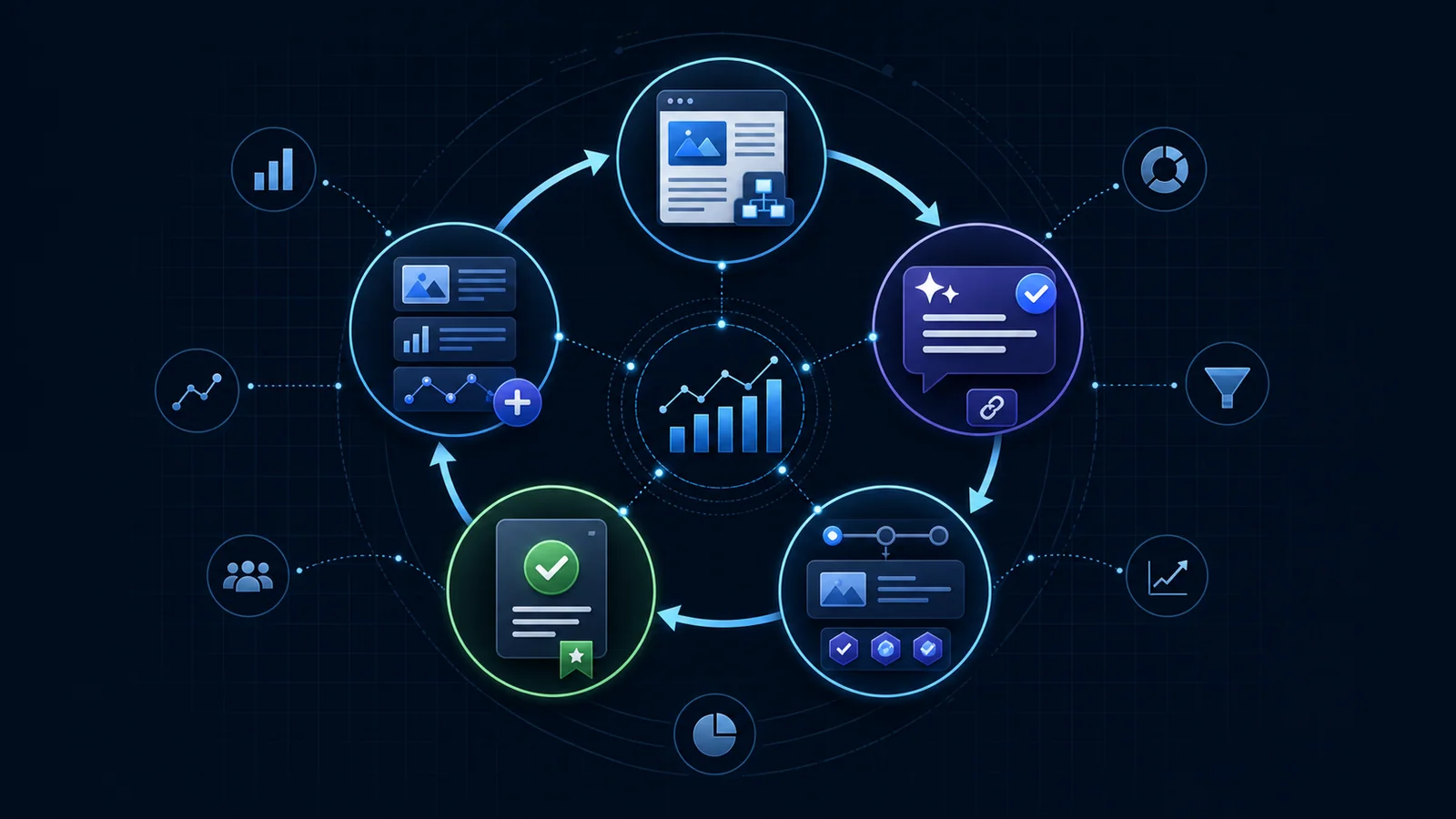
Build a ninety-day visibility system
During the first thirty days, audit crawler access, indexation, canonicals, rendered text, and existing analytics instrumentation. Map buyer questions to priority services, then identify which questions current pages answer and where evidence is missing. Over the next thirty days, publish decision guides, comparisons, and case studies while aligning company and service information across external profiles.
Use the final thirty days to review Search Console, Bing Webmaster Tools, referral sources, and conversion events together. Improve cited pages that fail to produce qualified action by examining intent and calls to action; improve pages that receive traffic but are not used as sources by strengthening clarity and evidence. Nova Pro Tech, operating in Türkiye as Nova Bilişim Teknolojileri, treats AI search visibility as a continuing system of technical access, verifiable information, consistent distribution, and measurement—not a one-time publishing campaign.
Sources
Related topics
- AI search
- B2B SEO
- generative search visibility